Outage to MyFirearms Login - Wednesday 16th September 7:00pm
The RealMe login for Myfirearms will be temporarily unavailable for 15-30 minutes during a scheduled update. The Firearms Licence Check and Dealer Transactions forms remain available.
New Zealand’s firearms laws are being updated and modernised, following extensive feedback from the firearms community.
Under these changes, Firearms Safety and Education New Zealand will be the name of New Zealand’s new firearms regulator. This new organisation reflects the Government’s intent for there to be an independent regulator delivering modern, user-focused services that enhance firearms safety, education, and compliance across New Zealand.
Firearms Safety and Education New Zealand will have responsibility for implementing the significant Arms Act 2026 legislative changes (when passed into law); and delivering operational and service improvements supported through Budget 2026.
Going forward, the delivery of firearms licensing and other regulatory services will be delivered by Firearms Safety and Education New Zealand, independent of NZ Police. NZ Police continue to focus on criminal law enforcement.
On this page we’ll provide the background information about these changes, and regularly update the firearms community and all New Zealand about what these changes mean, and how they will impact everyone.
The Committee’s report is a set of recommendations to all MPs. At the Second Reading on 21 July 2026, MPs debated the Select Committee report and its proposed changes, and the issues they heard from public submissions.
You can read a full transcript of the Second Reading debate on Parliament’s website.
You can also view a video of the Second Reading debate on Parliament’s website.
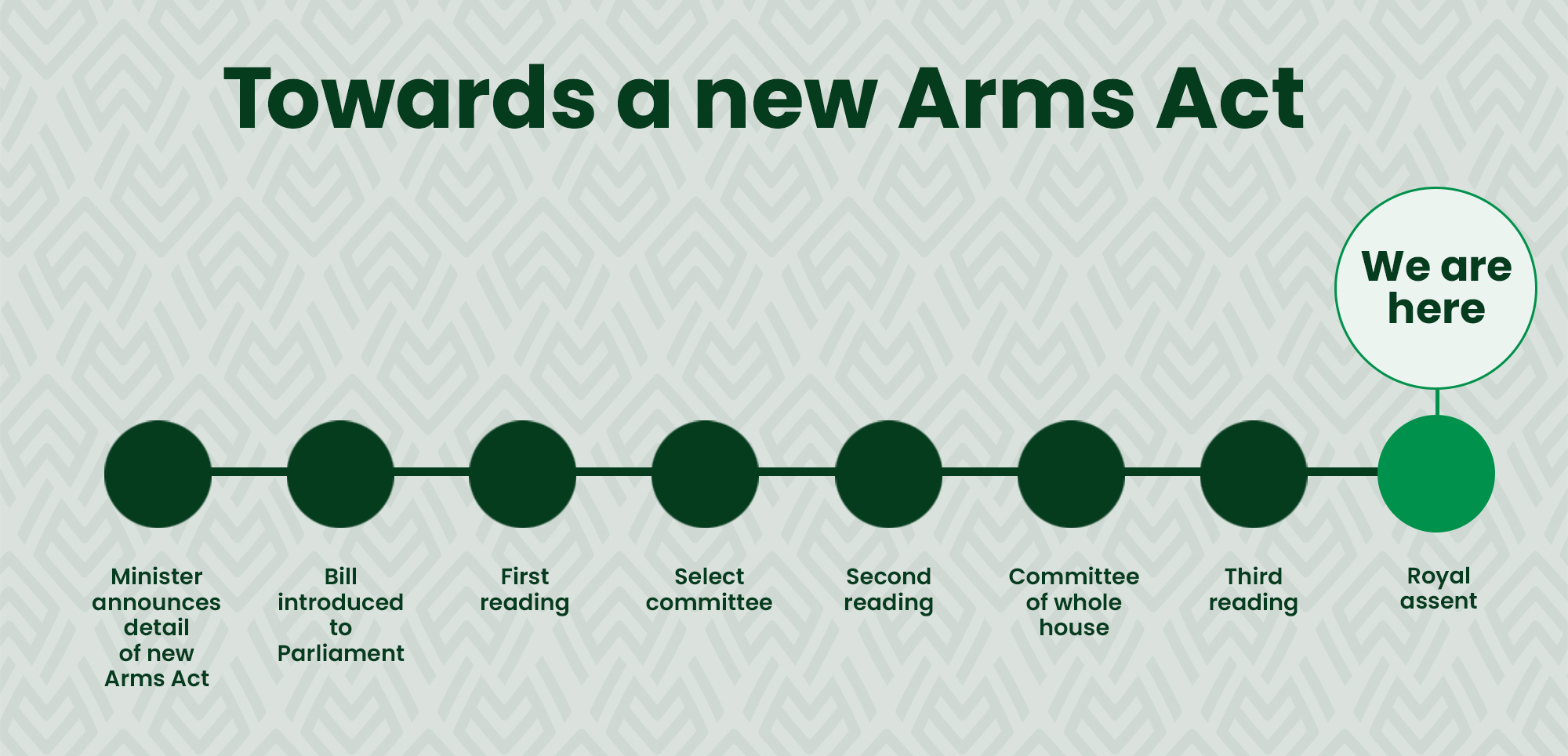
Parliament has passed the Arms Bill to repeal and replace the Arms Act 1983.
Some key changes include:
The new Act will also establish Firearms Safety and Education New Zealand as a new independent regulator of the firearms system, replacing Te Tari Pūreke - the Firearms Safety Authority, which is a branded business unit of the New Zealand Police.
The new agency will come into being on 23 September 2026.
Firearms Safety and Education New Zealand will be headed by an independent chief executive appointed by the Governor-General who will report to the responsible Minister.
The new agency will receive corporate services and support from the Police – things like Finance, IT and HR support. The Ministry of Justice will be responsible for monitoring it.
There is more information at:
It then becomes law after receiving the Royal Assent.
The new Arms Act 2026 (as it will be known then), comes into effect at the commencement date(s) outlined in the Act. Most of the new Act, along with new firearms regulations, will come into force on 23 September 2026, with some exceptions.
The requirements for commercial ammunition sellers will come into force on 23 July 2027 with existing ammunition sellers needing to have transitioned across the new system by 23 February 2028. The remaining policy proposals will come into force on 23 February 2028.
The Arms Bill focuses on four themes that will strengthen a culture of community safety, simplify regulatory settings, clarify and introduce regulatory requirements, and improve oversight of the firearms regulatory regime.
The Bill seeks to simplifies licensing and regulatory processes while maintaining safety standards, introducing business licences, improving import systems, simplifying requirements for employees, and creating new licence categories. They also strengthen oversight through an approvals system for ammunition sellers and updated endorsement settings for specific uses.
The Bill clarifies legal requirements and introduces proportionate enforcement tools to help users understand and meet their obligations, including requiring the reporting of surrendered firearms, creating pathways to bring unlawful firearms into legal possession, introducing an infringement regime, and updating offences and penalties to address gaps and emerging risks.
The Bill strengthens oversight and accountability of the firearms regulatory regime, ensuring decisions are transparent, consistent, and effectively monitored.
The Ministry of Justice have produced a handy list of changes in a Fact Sheet that outlines the current Arms Act provisions and proposed changes. You can view that downloadable PDF here.
Topic | Description |
| Modernised, fit-for-purpose legislation | When passed, the Arms Act 2026 creates a clearer and more straightforward regulatory framework. It modernises the legislation by restructuring it, updating the purpose section and key definitions, and shifting appropriate provisions to regulations. |
| A new firearms regulatory agency is created: Firearms Safety and Education New Zealand | The Act establishes the new independent firearms regulatory agency – Firearms Safety and Education New Zealand. It creates a new Chief Executive to lead the agency, and describes its core regulatory functions. |
| A Firearms Licensing Review Committee is established | An independent Firearms Licensing Review Committee replaces internal review processes for firearms licence applications. |
| Improvements to firearms licensing | There are several changes to firearms licence requirements, including explicitly prohibiting gang members from holding firearms licences, and coming in the future will be priority licence renewals for people needing to travel overseas at short notice with firearms. |
| ‘Business licences’ introduced | The Act will rename dealer licences as business licences. It extends the duration of business licences to five years for licence holders with good compliance records. This means licence holders on their third licence (second ‘renewal’) will become eligible for a five-year licence. |
| Curator and museum worker licences created | Museums are removed from the dealer/business licence regime and have a dedicated “Museum Licence”. Museum licence holders will also be eligible for a five-year licence, at their third-time licence application (second ‘renewal’). A new museum worker licence for museum employees is created that allows holders to handle arms items at their workplace as part of their duties. They will not need to maintain an individual firearms licence to hold a museum worker licence. |
| Visitor licences have greater flexibility | From 23 February 2028, visitor licences will allow people to use firearms while making multiple trips to New Zealand within an 18-month period. |
| More robust ammunition seller framework | From July 2027 ammunition sellers will require prior approval from the regulator, instead of just notifying of their intention to sell ammunition. |
| Improvements to licence ‘endorsements’ | The duration of restricted firearms endorsements issued for biosecurity control (formerly ‘pest control’) purposes is shifting to five years starting from 23 February 2028. Licence holders with collectors endorsements will be allowed from 23 February 2028 to store vital parts with other licence holders who do not need an endorsement to be able to store these parts. |
| Greater flexibility for some permits to possess | Firearms Safety and Education New Zealand will introduce multi-user agreements that allow specified employees of biosecurity and pest control organisations to share restricted firearms without triggering permit-to-possess or Registry updates for each short-term transfer of less than seven days. A biosecurity employee listed in a multi-user agreement can posses one or more restricted magazines and the same restricted firearm for seven days or less. |
| Permits to import clearer | Businesses will be able to bring in multiple consignments. Those consignments will be able to spread over the course of 12 months, as opposed to current requirements where permits are valid for 12 months but once a first consignment arrives, they have 30 days for all remaining consignments to come in, or the permit expires and a new permit required. |
| Greater clarity around manufacturing | From 23 September 2026, any arms item manufactured by licence holders can only be on-sold to business licence holders or via business licence holders. |
| Updates offences and penalties | Existing offences and penalties in the Act are updated and it introduces new offences and penalties. |
| Infringements for low-level non-compliance | The new Arms Act will allow the regulator in the future to issue infringements for low level non-compliance. This is not expected straight away, and will begin when an infringement regime is set up by the regulator, which may be 12 to 18 months away. |
| Greater flexibility introduced around licence suspensions | From 23 February 2028, suspensions for health-related reasons will last for 12 months, giving licence holders more time to seek medical advice and address concerns. |
| Regular fees reviews | There will be regular reviews of licence fees. The responsible Minister must review cost recovery levels at least once every 5-year period from the last time the fees were set. |
| Need help? | |
 |
Phone 0800 844 431 (04 499 2870) 8.30am to 5pm, Monday to Friday |